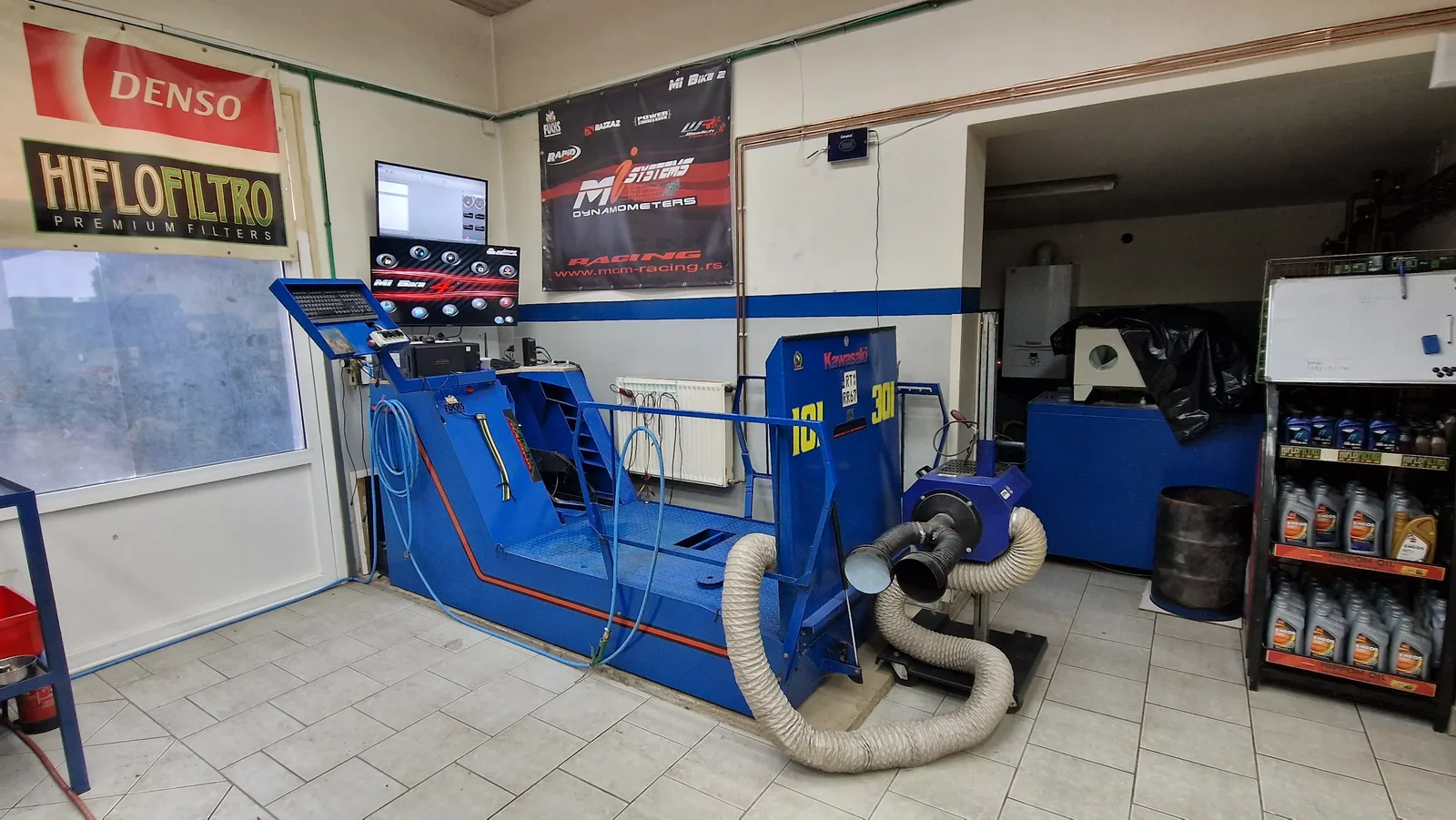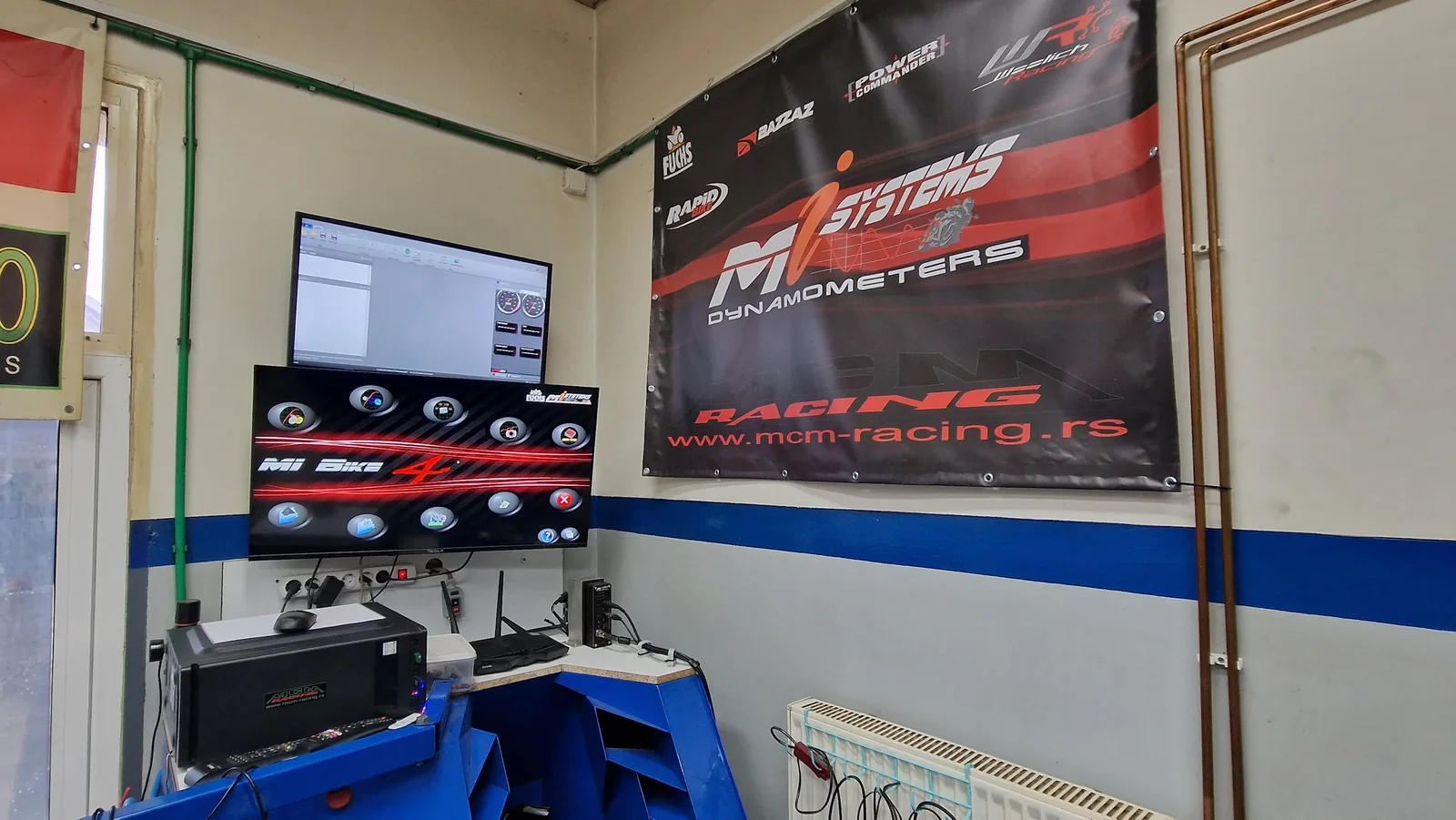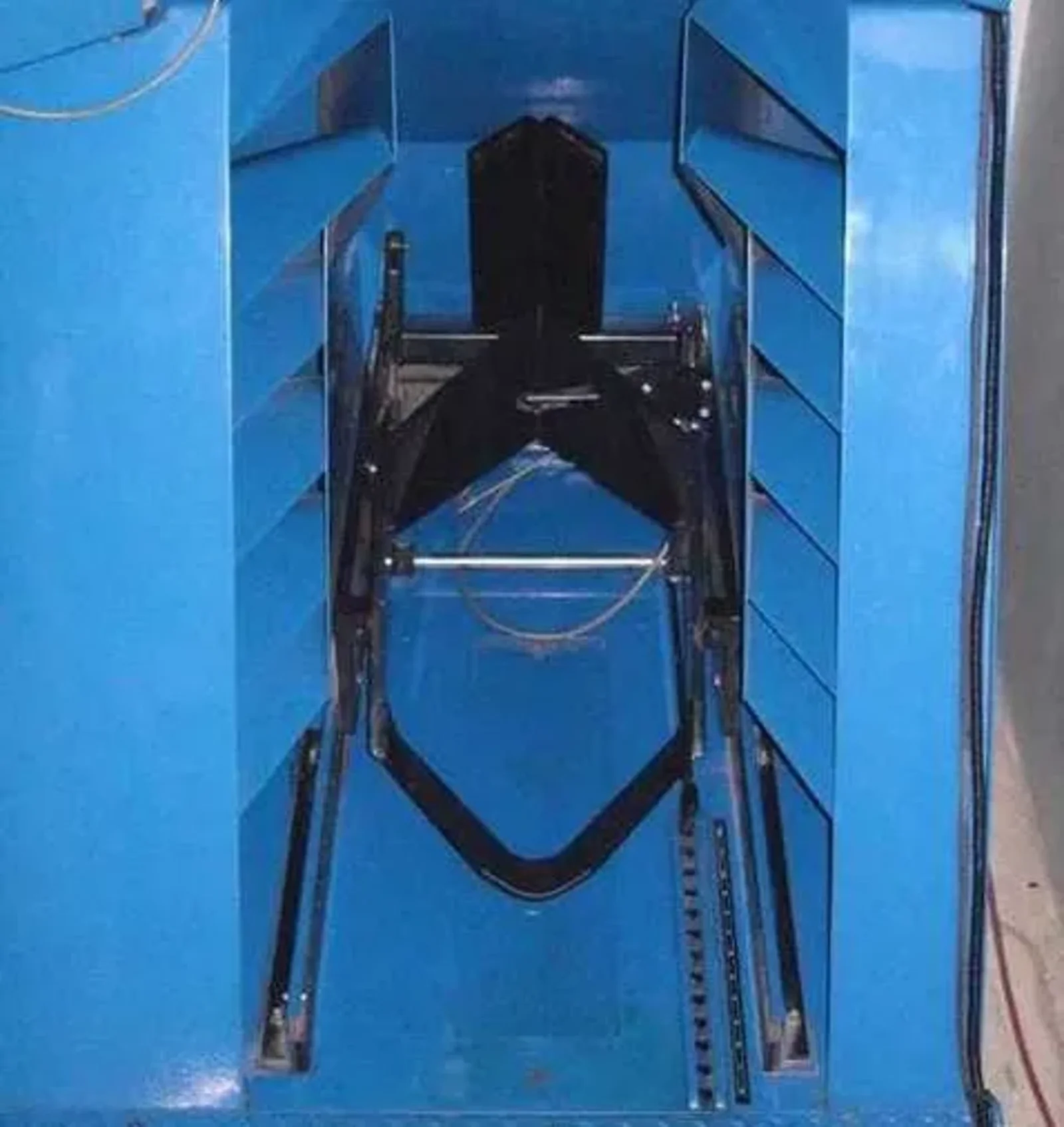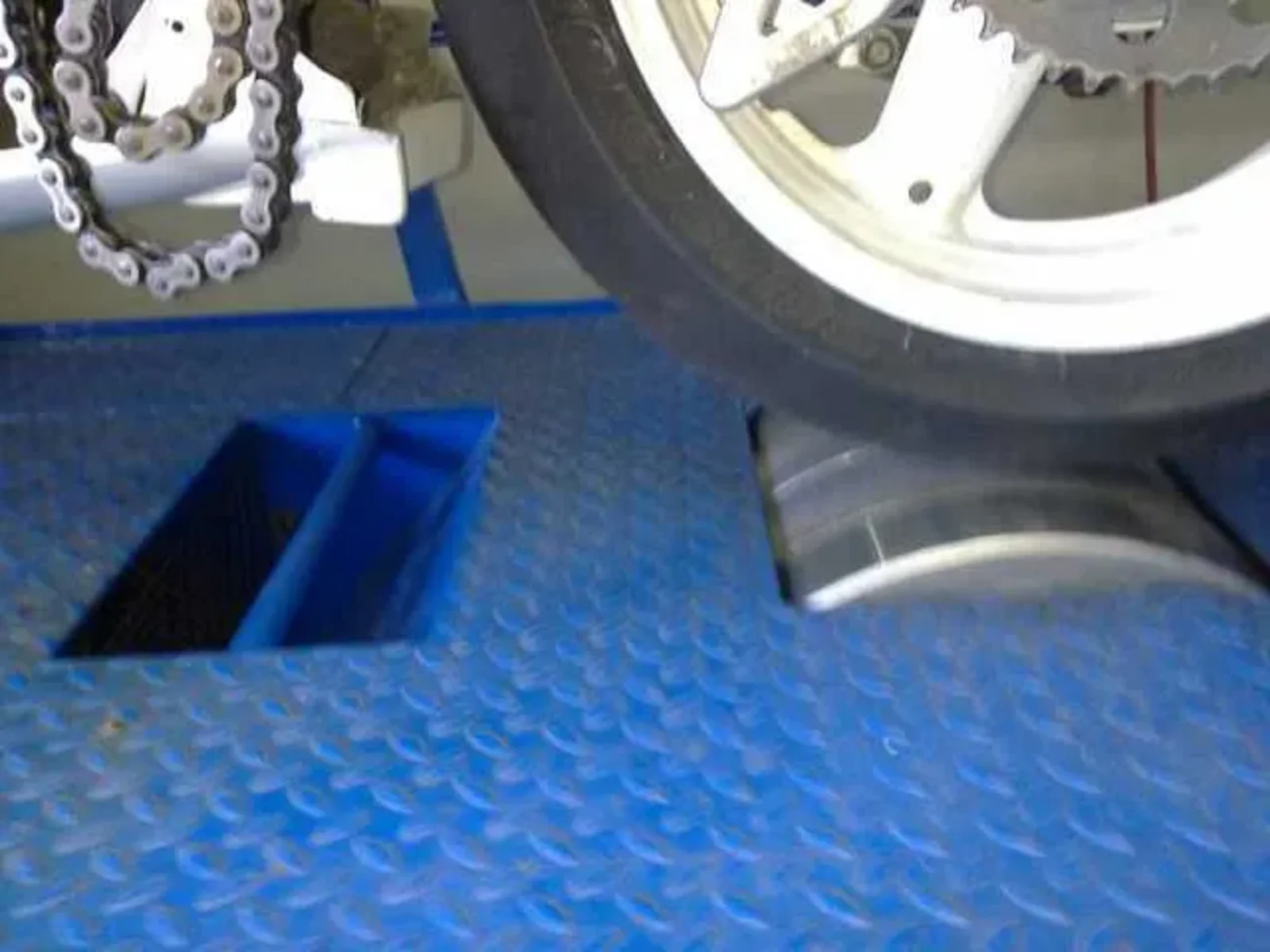
Naš servis koristi Fuchs Inercijalni dinamički dinamometar (Dyno ili probni sto) ) i dugogodišnje partnerstvo sa renomiranim proizvođačem Fuchs (sada Mi-Systems). Držeći korak sa tehnologijom, krajem 2025. godine smo izvršili potpunu nadogradnju na najnoviji hardver i softver direktno od proizvođača. Dyno je centralna tačka za postizanje optimalnih performansi vašeg motocikla. Probni sto nam omogućava precizno merenje konjske snage (KS), obrtnog momenta (Nm) na radilici ili točku i analizu toka smeše (AFR / Lambda) u realnom vremenu. Ova precizna oprema je ključna za profesionalno programiranje PowerCommander, Bazzaz, Rapid Bike i druge module, kao i za napredno reprogramiranje samog motornog računara (ECU Flash) Woolich Racing opremom. Naša oprema garantuje merljive i pouzdane rezultate.
1. Gustina podataka umesto statične tačke držanja
Statični sto (sa kočnicom) može da fiksira motor na konstantnoj radnoj tački. Ovo doduše omogućava vremenski intenzivno posmatranje, ali često dovodi do kritičnog lokalnog za/pregrevanja komponenti samog motocikla a i kočnice.
- Tehnološko rešenje: Moderni inercioni (dinamički) sistem sa HSI interfejsom (High Speed Interface) prikupljaju podatke ekstremno visokom frekvencijom. Čak i tokom kratkih prolaza kroz opteretnu ćeliju (npr. 15% TPS u 6. brzini na 3120 o/min) prikuplja se znatno više upotrebljivih podataka nego na klasičnim ispitnim stolovima.
- Statistička preciznost: Višestrukim prolaskom kroz opterećenje, Autotune softver prosečno izračunava dobijene vrednosti. Merne greške usled minimalnog proklizavanja ili kratkotrajnog trzanja statistički se eliminišu. Rezultat je precizna slika performansi u realnom kretanju.
2. Dinamički Autotune naspram statičkog mappinga
- Statički mapping (kočnica): Motor se optimizuje za stanja koja se u realnoj vožnji retko javljaju, jer konstantan broj obrtaja pod opterećenjem bez ikakvog ubrzanja predstavlja veštački scenario.
- Dinamički mapping (HSI-inercija): Optimizacija se vrši direktno u prelaznim područjima. Pošto se nepravilnosti poput trzanja uglavnom javljaju tokom ubrzanja ili u fazi opuštanja gasa, HSI sistem meri upravo taj dinamički trenutak.
- Efikasnost: Autotune softver upisuje korekcije direktno u mapu. Problematična područja često se koriguju već nakon nekoliko prolaza, čime se izbegava višesatno termičko opterećenje motora.
3. Prednost moderne HSI hardverske opreme
Presudni faktor za ovaj način rada je preciznost hardvera. Bez visokofrekventnog prikupljanja podataka, dinamičko merenje bi bilo isuviše neprecizno, jer bi vrednosti nestale u takozvanim „šumovima merenja“. Tek hardver sistema kao što je MI Systems omogućava softveru da iz kratkih sekvenci u visokoj brzini izračuna tačnu i uvek ponovljivu mapu.
Fazit i funkcionalno poređenje
- Očuvanje motora: Izbegavanje pregrevanja ventila i glava cilindra povećava sigurnost tokom postupka podešavanja.
- Realističnost: Greške se ispravljaju upravo u onom kretanju u kojem se i javljaju na putu.
- Brzina procesa: Automatski sistem koriguje mape tokom vožnje brže i preciznije nego što je moguće ručnim podešavanjem statičkih tačaka na kočnici.
Zaključak
Mišljenje da je kočnica neophodna za pronalaženje grešaka u delimičnom opterećenju zasniva se uglavnom na zastareloj inercijskoj elektronici. Sa sistemima poput Fuchs BEI 251 uključujući HSI i MI-MAP, klasična kočnica je tehnološki prevaziđena za većinu tuning primena. Snaga se ne određuje samo statički, već se optimizuje u dinamičkom toku.
Sistem Fuchs BEI 251 sa HSI (MI Systems)
Sistem Fuchs BEI 251 sa HSI (MI Systems) važi širom sveta među stručnjacima kao jedan od najkvalitetnijih i najpreciznijih moto ispitnih stolova, posebno za dinamičko tjuniranje.
Objektivna svetska klasifikacija sistema
1. Tehnološki vrhunska klasa (HSI)
U poređenju sa rasprostranjenim sistemima poput Dynojet (čest standard u SAD-u), HSI tehnologija nudi znatno višu rezoluciju podataka. Dok mnogi standardni ispitni stolovi moraju softverski „ispeglati“ krive kako bi potisnuli šumove, HSI interfejs isporučuje tako čiste sirove podatke da su i najmanje promene snage u opsegu od 0,1 KS realno vidljive.
2. Softver (MI-MAP / MI-BIKE)
Softver MI Systems ceni se globalno jer sadrži duboku bazu podataka sa preko 1.600 modela i precizne korektivne faktore za inerciju i gubitke trenja.
- Prednost nad konkurencijom: Mnogi sistemi mere samo „snagu na točku“ i grubo procenjuju snagu na radilici. MI sistem, zahvaljujući visokom kvalitetu podataka, omogućava vrlo precizno preračunavanje na snagu radilice — što je od ključnog značaja za profesionalne tunere.
3. Autotune efikasnost
- Poređenje: Dok drugi sistemi bazirani na statičkim tačkama (kočnica) često dovode do „mapa pregrevanja“, Fuchs sistem kreira mape zasnovane na realnoj dinamici ubrzanja. To često dovodi do bolje voznosti na putu i trkačkoj stazi.
4. Svetska reputacija
- Evropa: Fuchs BEI 251 je često prvi izbor za visokokvalitetne tjunere i trkačke timove koji cene tehničku dubinu i dugotrajnost.
- SAD/Australija: Tamo dominiraju inercioni stolovi poput Dynojet, ali tehnički stručnjaci često nazivaju Fuchs „tehnički superiornim Evropljaninom“.
Fazit
Globalno gledano, sa Fuchs BEI 251 HSI ne dobijaš „običan proizvod“, već precizni instrument. Idealno rešenje za tjunere koji:
- Traže maksimalnu ponovljivost
- Žele podešavanje uz minimalno opterećenje motora
- Zahtevaju realne vrednosti KS bez softverskog ulepšavanja
Svetska klasifikacija za 2026. godinu
1. Tehnološki „zlatni standard“ u Evropi
U Evropi, posebno u Nemačkoj, Francuskoj i Velikoj Britaniji, Fuchs ispitni sto je referenca za profesionalno tjuniranje i pripremu za trke. Dok američke marke poput Dynojet imaju najveću rasprostranjenost, Fuchs sistem sa HSI preferiraju specijalizovani tjuneri koji zahtevaju apsolutni integritet podataka.
2. Prednost HSI kvaliteta podataka
- Dynojet i drugi: Ovi sistemi često snažno „uglađuju“ krive, što daje lep grafik, ali prikriva fine detalje u radu motora (npr. minimalne prekide paljenja ili oscilacije smeše).
- Fuchs HSI: Sistem pruža tako visoku frekvenciju uzorkovanja da se smatra jednim od retkih inercionih sistema koji u detaljnosti mogu konkurisati znatno skupljim motornim laboratorijskim stolovima.
3. Preciznost izračunavanja snage na radilici
- Koeficijente trenja
- Gubitke u menjaču
- Inerciju obrtnih delova
4. Reputacija u motosportu
Rezultat merenja na Fuchs-HSI stolu smatra se „pouzdanim“. Ako tim u Japanu i tim u Evropi mere na Fuchs sistemu sa istim MI-MAP parametrima, rezultati su gotovo identični i direktno uporedivi.
Zaključak: Gde sistem stoji globalno?
- Udeo na tržištu: Ne najveći (ovde vodi Dynojet zbog agresivnog marketinga u SAD).
- Tehnološki rang: Top 3 najpreciznija valjkasta sistema na svetu.
- Imidž: „Inženjerski ispitni sto“. Ko poseduje Fuchs BEI 251 sa HSI, pokazuje tehničko znanje koje prevazilazi obična merenja snage.
1. Daten-Dichte statt statischem Haltepunkt
Ein gebremster Prüfstand fixiert den Motor an einem konstanten Betriebspunkt. Dies ermöglicht zwar eine zeitintensive Beobachtung, führt jedoch häufig zu einer kritischen lokalen Überhitzung der Bauteile.
- Technologische Lösung: Moderne Trägheitssysteme mit einem HSI-Interface (High Speed Interface) erfassen Daten mit einer extrem hohen Frequenz. Selbst bei kurzen Durchläufen einer Lastzelle (z. B. 15 % TPS im 6. Gang bei 3120 U/min) werden deutlich mehr verwertbare Datenpunkte gesammelt als bei herkömmlichen Prüfständen.
- Statistische Präzision: Durch das mehrmalige Durchfahren der Lastbereiche mittelt die Autotune-Software die erfassten Werte. Messfehler durch minimalen Schlupf oder kurzzeitiges Ruckeln werden so statistisch eliminiert. Das Ergebnis ist eine präzise Abbildung der Leistung im realen Bewegungsablauf.
2. Dynamisches Autotune versus statisches Mapping
- Statisches Mapping (Bremse): Hierbei wird der Motor für Zustände optimiert, die im realen Fahrbetrieb selten vorkommen, da eine konstante Drehzahl unter Last ohne jegliche Beschleunigung ein künstliches Szenario darstellt.
- Dynamisches Mapping (HSI-Inertia): Die Optimierung erfolgt direkt im Übergangsbereich. Da Unregelmäßigkeiten wie Ruckeln meist während der Beschleunigung oder im Schiebebetrieb auftreten, misst das HSI-System exakt diesen dynamischen Moment.
- Effizienz: Die Autotune-Software schreibt Korrekturen direkt in das Kennfeld. Problematische Bereiche sind oft bereits nach wenigen Durchgängen korrigiert, was eine stundenlange thermische Belastung des Motors vermeidet.
3. Die Überlegenheit moderner HSI-Hardware
Der entscheidende Faktor für diese Arbeitsweise ist die Hardware-Präzision. Ohne eine hochfrequente Datenerfassung wäre das dynamische Abfahren zu ungenau, da die Werte im sogenannten "Messrauschen" untergehen würden. Erst die Hardware von Systemen wie MI Systems ermöglicht es der Software, aus den kurzen Sequenzen im hohen Gang eine exakte und jederzeit wiederholbare Map zu berechnen.
Fazit und funktioneller Vergleich
- Motorschonung: Die Vermeidung von Hitzestau an Ventilen und Zylinderköpfen erhöht die Sicherheit während des Abstimmprozesses.
- Realitätsnähe: Fehler werden in genau der Bewegung behoben, in der sie auch auf der Straße auftreten.
- Prozessgeschwindigkeit: Ein automatisiertes System korrigiert Kennfelder beim Abfahren schneller und präziser, als es durch eine manuelle Ansteuerung statischer Zellen auf einer Bremse möglich wäre.
Schlussfolgerung
Die Ansicht, eine Bremse sei für die Teillast-Fehlersuche zwingend erforderlich, bezieht sich primär auf veraltete Trägheitselektronik. Mit Systemen wie dem Fuchs BEI 251 inklusive HSI und MI-MAP ist die klassische Bremse für den Großteil aller Tuning-Anwendungen technologisch überholt. Die Leistung wird nicht nur statisch ermittelt, sondern im dynamischen Fluss optimiert.
Das System Fuchs BEI 251 mit HSI (MI Systems)
Das System Fuchs BEI 251 mit HSI (MI Systems) gilt weltweit unter Fachleuten als einer der hochwertigsten und präzisesten Motorrad-Prüfstände, insbesondere für das dynamische Tuning.
Objektive Einordnung des Systems im globalen Vergleich
1. Technologische Spitzenklasse (HSI)
Im Vergleich zu weit verbreiteten Systemen wie Dynojet (oft der Standard in den USA) bietet die HSI-Technologie eine deutlich höhere Auflösung der Messdaten. Während viele Standard-Prüfstände softwareseitig Kurven "glätten" müssen, um Rauschen zu unterdrücken, liefert das HSI-Interface so saubere Rohdaten, dass selbst kleinste Leistungsänderungen im Bereich von 0,1 PS real sichtbar werden.
2. Die Software (MI-MAP / MI-BIKE)
Die Software von MI Systems wird weltweit geschätzt, da sie eine tiefgreifende Datenbank mit über 1.600 Modellen sowie präzise Korrekturfaktoren für Massenträgheit und Reibungsverluste enthält.
- Vorteil gegenüber Konkurrenz: Viele Systeme messen nur "Rad-Leistung" und schätzen die Kurbelwellenleistung grob. Das MI-System erlaubt durch die hohe Datenqualität eine sehr exakte Rückrechnung auf die Kurbelwellenleistung, was für professionelle Motorenbauer entscheidend ist.
3. Autotune-Effizienz
- Vergleich: Während andere Systeme auf statischen Haltepunkten (Bremse) oft zu "Hitzestau-Kennfeldern" führen, generiert das Fuchs-System Kennfelder, die auf der realen Beschleunigungsdynamik basieren. Das führt oft zu einer besseren Fahrbarkeit im Straßen- oder Rennstreckenbetrieb.
4. Weltweiter Ruf
- Europa: Hier ist der Fuchs BEI 251 oft die erste Wahl für High-End-Tuner und Rennteams, die Wert auf technische Tiefe und Langlebigkeit legen.
- USA/Australien: Dort dominieren zwar Trägheitsprüfstände wie Dynojet den Massenmarkt, aber technische Experten bezeichnen den Fuchs oft als den „technisch überlegenen Europäer“.
Fazit
Weltweit betrachtet hast du mit dem Fuchs BEI 251 HSI kein „08/15“-Produkt, sondern ein Präzisionsinstrument. Es ist die ideale Lösung für Tuner, die:
- Maximale Wiederholbarkeit suchen
- Motorschonend auf höchstem Niveau abstimmen wollen
- Echte, ehrliche PS-Zahlen ohne künstliche Software-Glättung benötigen
Weltweite Einordnung für das Jahr 2026
1. Der technologische „Goldstandard“ in Europa
In Europa, insbesondere in Deutschland, Frankreich und Großbritannien, gilt der Fuchs-Prüfstand als Referenz für professionelles Motorentuning und Rennsport-Vorbereitung. Während US-amerikanische Marken wie Dynojet weltweit die höchste Verbreitung haben, wird das Fuchs-System mit HSI von spezialisierten Tunern bevorzugt, die absolute Datenintegrität benötigen.
2. Überlegenheit der HSI-Datenqualität
- Dynojet & Co: Diese Systeme arbeiten oft mit stärkerer softwareseitiger Glättung der Kurven, was zwar schöne Graphen liefert, aber feine Details im Motorlauf (wie minimale Zündaussetzer oder Gemischschwankungen) verbergen kann.
- Fuchs HSI: Das System liefert eine so hohe Abtastrate, dass es weltweit als eines der wenigen Inertia-Systeme gilt, die in der Detailtiefe mit deutlich teureren Motorenprüfständen konkurrieren können.
3. Exaktheit der Kurbelwellen-Berechnung
- Reibungskoeffizienten
- Getriebeverluste
- Massenträgheit der rotierenden Bauteile
Dadurch kann das System die Kurbelwellenleistung präziser zurückrechnen als fast jedes andere rollenbasierte System weltweit, das oft nur pauschale Prozentwerte abzieht.
4. Reputation im Rennsport
Ingenieure schätzen das System weltweit für seine Reproduzierbarkeit. Ein Messergebnis auf einem Fuchs-HSI-Prüfstand gilt als „belastbar“. Wenn ein Team in Japan und ein Team in Europa beide auf einem Fuchs-System mit den gleichen MI-MAP-Parametern messen, sind die Ergebnisse nahezu identisch und direkt vergleichbar.
Zusammenfassung: Wo steht das System weltweit?
- Marktanteil: Nicht der größte (hier führt Dynojet aufgrund der aggressiven US-Vermarktung).
- Technologie-Rang: Unter den Top 3 der weltweit präzisesten Rollenprüfstände.
- Image: Der „Ingenieurs-Prüfstand“. Wer einen Fuchs BEI 251 mit HSI besitzt, signalisiert weltweit technisches Know-how, das über das bloße „Power-Run“-Ablesen hinausgeht.
1. Data Density Instead of a Static Holding Point
A braked test bench fixes the engine at a constant operating point. This allows for time-intensive observation, but often leads to critical local overheating of components.
- Technological solution: Modern inertia (dynamic) systems with an HSI interface (High Speed Interface) record data at an extremely high frequency. Even during short passes of a load cell (e.g., 15% TPS in 6th gear at 3120 rpm), significantly more usable data points are collected than with conventional test benches.
- Statistical precision: By running through the load ranges multiple times, the Autotune software averages the recorded values. Measurement errors caused by minimal slip or short jolts are statistically eliminated. The result is an accurate representation of performance during real-world operation.
2. Dynamic Autotune Versus Static Mapping
- Static mapping (brake): The engine is optimized for conditions that rarely occur in real driving, because maintaining a constant RPM under load without any acceleration is an artificial scenario.
- Dynamic mapping (HSI inertia): Optimization takes place directly in transitional areas. Since irregularities such as jerking mostly occur during acceleration or deceleration, the HSI system measures precisely these dynamic moments.
- Efficiency: The Autotune software writes corrections directly into the map. Problematic areas are often corrected after just a few passes, avoiding prolonged thermal stress on the engine.
3. The Superiority of Modern HSI Hardware
The decisive factor for this working method is hardware precision. Without high-frequency data acquisition, dynamic runs would be too inaccurate, as values would disappear in the so-called “measurement noise.” Only the hardware of systems like MI Systems enables the software to calculate an exact and repeatable map from short sequences in high gear.
Conclusion and Functional Comparison
- Engine protection: Avoiding heat accumulation at valves and cylinder heads increases safety during the tuning process.
- Real-world relevance: Errors are corrected in exactly the same movement in which they also occur on the road.
- Process speed: An automated system corrects maps more quickly and precisely during runs than is possible through manual control of static cells on a brake.
Conclusion
The belief that a brake is essential for part-load error detection primarily refers to outdated inertia electronics. With systems such as the Fuchs BEI 251 including HSI and MI-MAP, the classical brake is technologically outdated for most tuning applications. Performance is not only determined statically but optimized dynamically.
The Fuchs BEI 251 System with HSI (MI Systems)
The Fuchs BEI 251 system with HSI (MI Systems) is considered one of the highest-quality and most precise motorcycle test benches worldwide, especially for dynamic tuning.
Objective Classification of the System in Global Comparison
1. Technological Top Class (HSI)
Compared to widely used systems such as Dynojet (often the standard in the USA), HSI technology offers significantly higher resolution of measurement data. While many standard test benches need to “smooth” curves via software to suppress noise, the HSI interface delivers raw data so clean that even the smallest performance changes in the 0.1 hp range are accurately visible.
2. The Software (MI-MAP / MI-BIKE)
The software from MI Systems is valued worldwide because it includes a deep database with over 1,600 models as well as precise correction factors for inertia and friction losses.
- Advantage over competitors: Many systems measure only “wheel power” and roughly estimate crankshaft power. The MI system allows highly accurate back-calculation to crankshaft power thanks to the high data quality, which is crucial for professional engine builders.
3. Autotune Efficiency
- Comparison: While other systems using static holding points (brake) often lead to “heat-soak maps,” the Fuchs system generates maps based on real acceleration dynamics. This often results in better rideability on both road and racetrack.
4. Worldwide Reputation
- Europe: The Fuchs BEI 251 is often the first choice for high-end tuners and racing teams that value technical depth and durability.
- USA/Australia: Although inertia test benches like Dynojet dominate the mass market, technical experts often refer to the Fuchs as the “technically superior European.”
Conclusion
Viewed worldwide, the Fuchs BEI 251 HSI is not an “average product,” but a precision instrument. It is the ideal solution for tuners who:
- Seek maximum repeatability
- Want to tune with minimal stress on the engine
- Require real, honest horsepower numbers without artificial software smoothing
Worldwide Classification for the Year 2026
Globally, the Fuchs BEI 251 with HSI (MI Systems) holds a special position. In expert circles, it is considered the “precision instrument” among motorcycle test benches, while other systems mainly serve the mass market.
1. The Technological “Gold Standard” in Europe
In Europe—especially Germany, France, and the UK—the Fuchs test bench is regarded as the reference for professional engine tuning and race preparation. While American brands like Dynojet have the highest worldwide distribution, the Fuchs system with HSI is preferred by specialized tuners who require absolute data integrity.
2. Superiority of HSI Data Quality
- Dynojet & others: These systems often rely on heavy software smoothing of the curves, which produces nice-looking graphs but conceals fine details in engine behavior (such as minimal ignition drops or mixture fluctuations).
- Fuchs HSI: The system provides such a high sampling rate that it is considered one of the few inertia systems globally that can compete in detail depth with significantly more expensive engine lab test benches.
3. Precision of Crankshaft Power Calculation
- Friction coefficients
- Gearbox losses
- Inertia of rotating components
This allows the system to calculate crankshaft power more accurately than almost any other roller-based system worldwide, which often applies only rough percentage deductions.
4. Reputation in Motorsport
Engineers worldwide appreciate the system for its reproducibility. A measurement on a Fuchs-HSI test bench is considered “reliable.” If a team in Japan and a team in Europe both measure on a Fuchs system with the same MI-MAP parameters, the results are nearly identical and directly comparable.
Summary: Where Does the System Stand Worldwide?
- Market share: Not the largest (Dynojet leads here due to aggressive U.S. marketing).
- Technology ranking: Among the top 3 most precise roller test benches worldwide.
- Image: The “engineer’s test bench.” Owning a Fuchs BEI 251 with HSI signals technical expertise far beyond simple “power-run” readings.